
Last week, I had the opportunity to speak remotely with approximately 200 master’s and doctoral students at Universitas Negeri Jakarta (UNJ), Indonesia, as part of the university’s English Program for Postgraduate Students. The students came from a wide variety of fields, from sports science to engineering to humanities. The two-hour online workshop, Maintaining Your Authentic Voice in Scholarly Presentations: Ethical and Effective Uses of Generative AI, considered a problem that is becoming increasingly important in my teaching and research: how to use generative AI (genAI) without losing our local standpoint?
This online workshop was a challenge for me, especially as the organizers and I wanted to alternate between online lessons and in-person discussion among the workshop participants. The team on the ground was very helpful in getting the students talking to each other about the exercises I prepared.
From a research topic to a research story
Before the workshop, I surveyed participants with a needs-assessment survey that I used to shape the session. Their responses reinforced something I have noticed repeatedly: the difficult part of scholarly presentation is often not knowing what to say, but turning it into spoken communication. Many participants identified speaking naturally without reading a script and presenting in English as important challenges.
My main response has been that a conference presentation is not an English-language performance. Two of the goals of conference presentations relate to networking and getting feedback. Here in ASEAN, presenters and audience members are speaking English as a second, third, or fourth language. Thinking about the audience as potential collaborators rather than judges can go a long way to calming students’ nerves. If you’re lucky, you’ll get comments that preview what kinds of peer review comments you’ll get when you submit your paper to a journal.
In order to drive this point, I distinguished between a topic and a problem.
For instance, a topic would be: “My research is about bilingual education.” This tells an audience about what you’re going to say, but it does not help people understand why you are doing research. A problem statement could be something like: “Current approaches to bilingual education do not reflect the needs of students in Southeast Asia.” This gives the audience a reason to listen … and prepares people to give you feedback … and it might end up motivating someone to reach out for future collaboration.
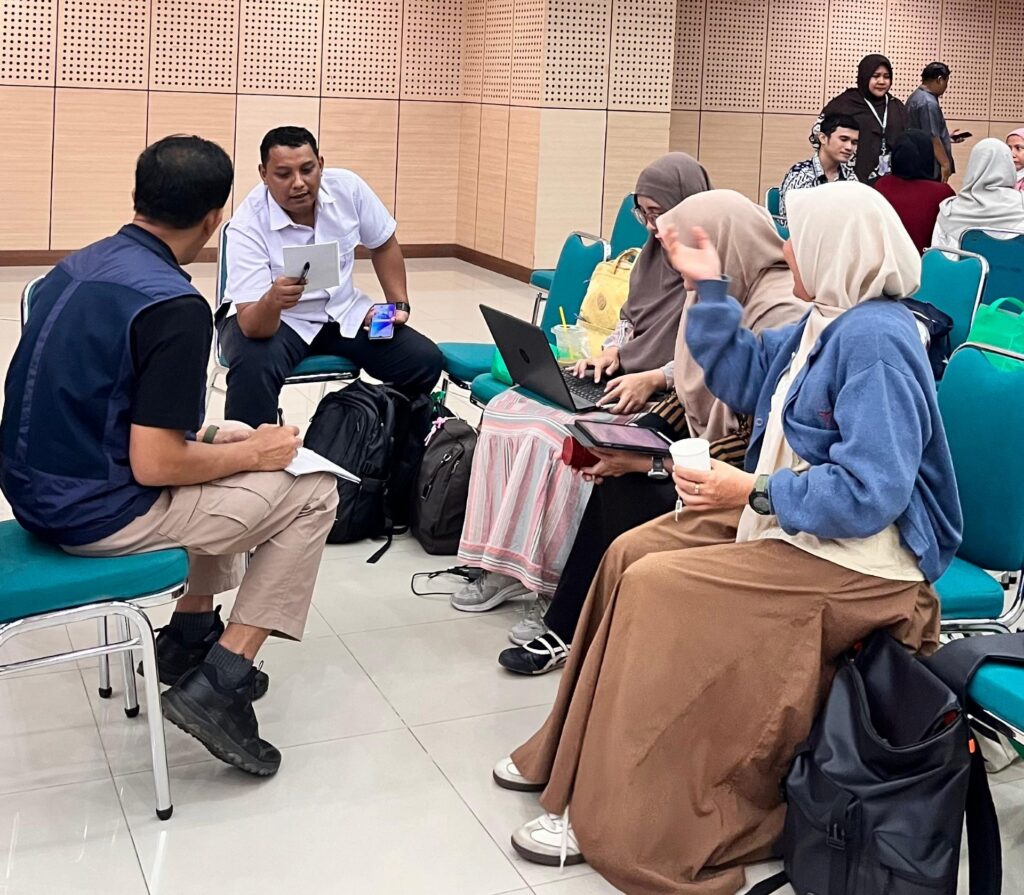
The workshop consisted of lecture modules that were reinforced with small-group activities.
The activities I designed were intentionally based on participants’ own knowledge. I decided to forgo practicing with a generic discussion topic. Instead, I asked them to explain a real or prospective research problem to the nearby postgrad students. This creates a useful change in emphasis. Instead of asking, “Was my English perfect?” the presenter can ask, “Did another scholar understand what I meant?”
GenAI knows little of what you know
The second part of the workshop turned to GenAI itself. In the preworkshop survey, students overwhelmingly stated that genAI can be an effective form of brainstorming. I think it is important to nuance this idea because genAI tools are not as universal as they seem. As my current research is starting to show, they do not provide information equally about all regions.
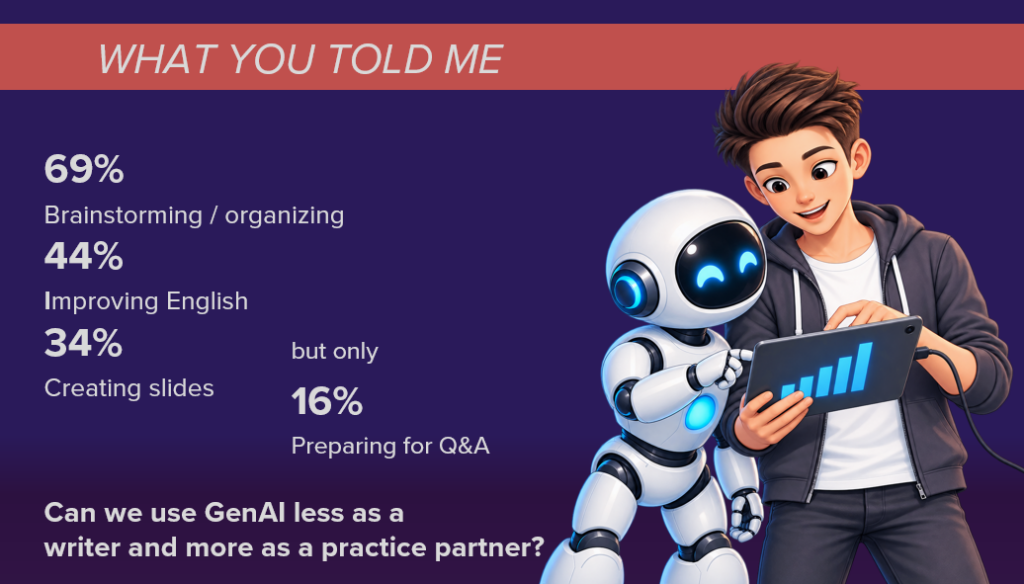
Based on my current research, I have started to question the utility of chatbots for brainstorming …
One of my favorite exercises to do with postgrad students is to ask them to brainstorm a list of challenges facing people like them, in their local context and in their professional world. This sequence matters: student first, genAI second. If students take this exercise seriously – writing from their hearts and not looking up ideas online – they can take an important step. Ask your favorite AI chatbot the same question. The answers made by genAI are plausible, but they come from an outsider’s perspective. This drives home an important point: the training of genAI tools does not have a lot of input from people in regions like Southeast Asia.
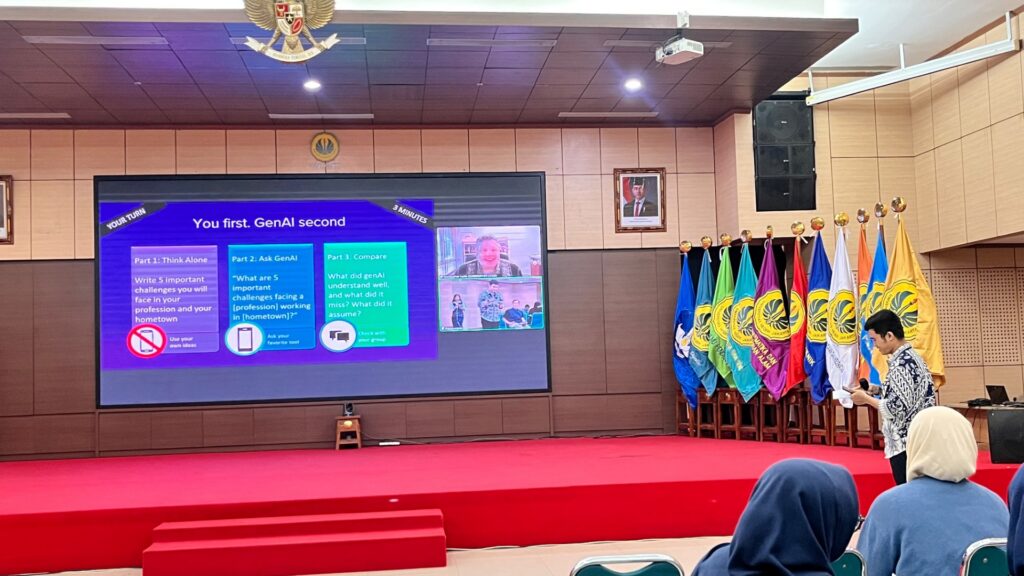
One of the hands-on activities involved comparing one’s own ideas with the generic chatbot advice.
For that reason, I discourage people from thinking of genAI tools as a neutral source of brainstorming. Chatbots can be very useful for generating alternatives, identifying possible audience questions, and providing language feedback. However, they can also overlook local conditions, flatten differences, and confidently reproduce mistaken generalizations.
That led to another central question: What do you know that GenAI does not? Your experience, institution, community, profession, and location are forms of situated knowledge that may be poorly represented in model training data. Take a look at the genAI output about challenges in your city, and transpose the setting to Paris or Miami. Often, the challenges still fit in – that’s just a function of how chatbots come up with their output. So, the brainstorming starts to seem less than effective.
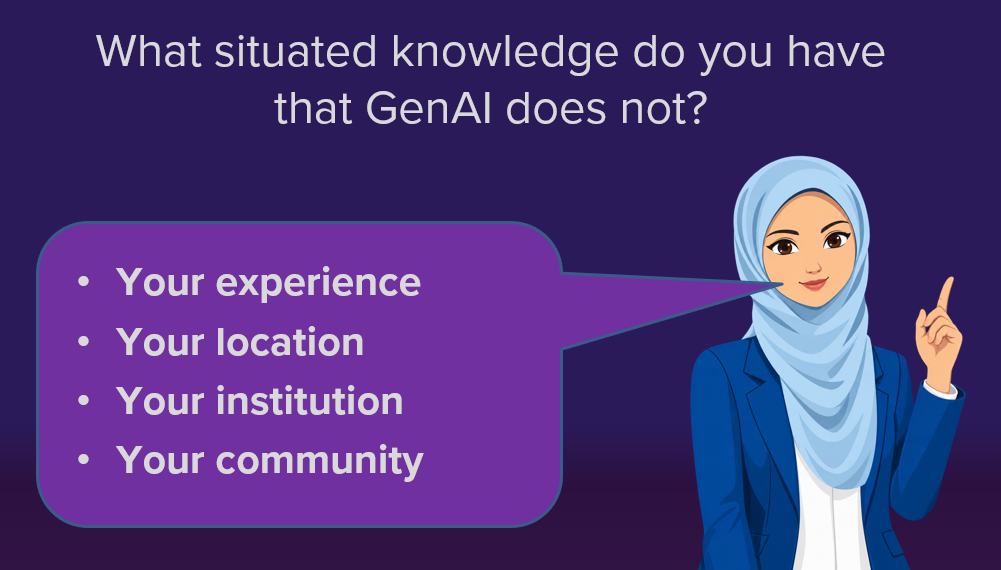
The contexts of Southeast Asia are relevant to many people in the international audience.
One of the participants reported his beliefs about the challenges of being an English teacher. Then, he reported the genAI output. Not surprisingly (to me at least) was that the chatbot’s assumptions about teaching challenges were more applicable to teachers in Anglophone countries – and for the few points that were geared toward the context of Southeast Asia, they were from the worldview of an outsider.
For instance, chatbots like to say that teaching challenges include things like large class sizes and the lack of access to professional development activities. The latter was kind of ironic, given that we were in the midst of a professional development activity in Southeast Asia. The former, though, is just a fact of life. Class sizes for a variety of reasons tend to be much larger than an educator from the U.S. would expect. We can wish that classes were smaller, but the large class size is a daily reality. I have learned from my students and colleagues that education can still be successful in this context, even though the chatbots’ training data lead them to believe that it is one of the biggest challenges.
A presentation is not a document
We also considered something genAI tools can make surprisingly easy to forget: a slide is support for an oral presentation. It is not a written document. A written document needs to explain itself, but a presentation has a speaker. The needs of networking and gaining feedback need a presenter, not someone reading a script.
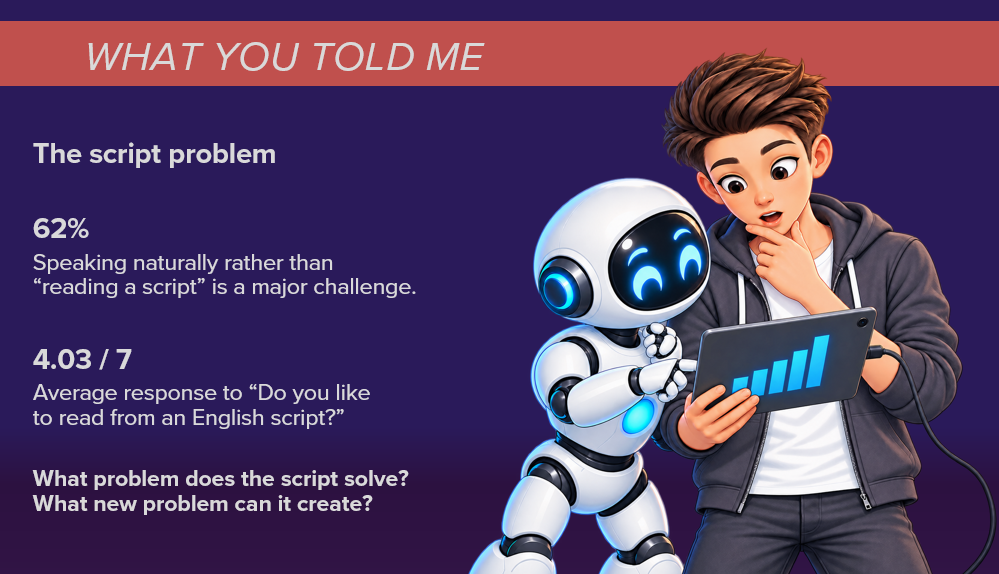
I encouraged students to remember a conference presentation is not an English speaking competition.
I showed a deliberately overloaded slide containing multiple graphics, competing claims, small text, and several strands of evidence. It looked reasonably sophisticated—almost like a miniature academic poster—but it gave the audience no clear indication of where to look while the speaker was talking.
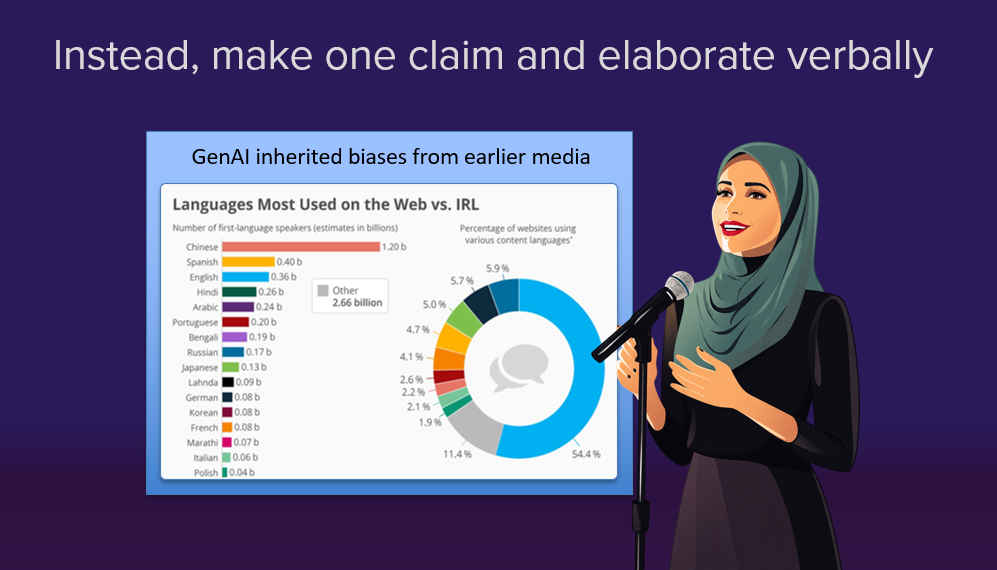
Keeping slides simple and augmenting them with verbal commentary is the best strategy.
I then reduced it to one claim and one visual. The point was not that scholarly ideas have to become simplistic. Rather, complexity can remain in the researcher’s explanation instead of being compressed into tiny boxes on a slide.
What does an “authentic scholarly voice” mean?
After establishing this groundwork, I was able to assert the central message. An authentic voice does not mean being informal, imitating a supposedly native speaker (whoever that is). To me, authenticity means something practical: information you choose and understand, that fits in with personal experience. Most importantly, the speaker can see themselves and their city in the ideas. General presentations that could be written by anyone may use good English and seem plausible, but they do not reflect the insights of a local person.
That seems to me a much more interesting ethical problem than simply asking whether a researcher “used AI.” The experiences of people in Southeast Asia are not peripheral to the international conversation; in many respects, they may be more representative of global conditions than the contexts most heavily represented in Anglophone training data. The challenges professionals face, in Indonesia as well as Thailand, are probably more familiar to professionals globally. Therefore, our research can be relevant and useful to international scholars if we maintain our local perspectives.
There is nothing wrong with using genAI tools. Language assistance does not automatically eliminate intellectual ownership. The more important question to me is, which decisions have been delegated – and the extent to which local contexts are the starting point for new knowledge.
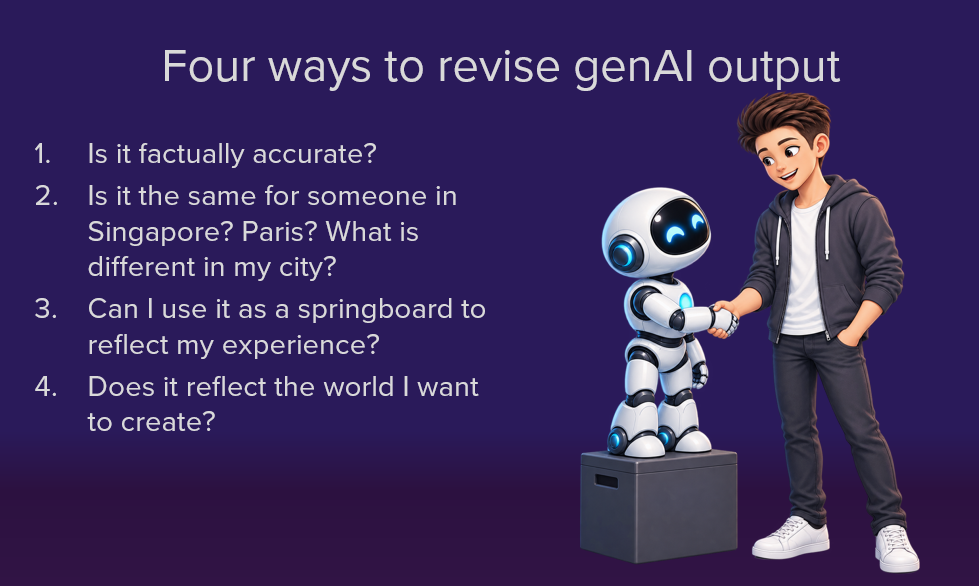
My suggestions on how to revise chatbot output to reflect the local context.
At the end of the workshop, I offered four suggestions on how to adapt genAI output for English-language presentations. The first question is familiar: is the output factually correct? The other questions I encouraged students to ask, though, I hope were new. Would the output be the same for someone in Singapore or Paris? How does the output offer a springboard into my own experience? Maybe most importantly are local needs and aspirations: Does the output reflect the world you want to create?
GenAI enters the process, but it does not begin or end it.
I delivered the session from Thailand, but I hope this will be the beginning rather than the end of my relationship with my new friends at Universitas Negeri Jakarta. I thank them for their kind invitation, participation, and support that made the workshop a success.
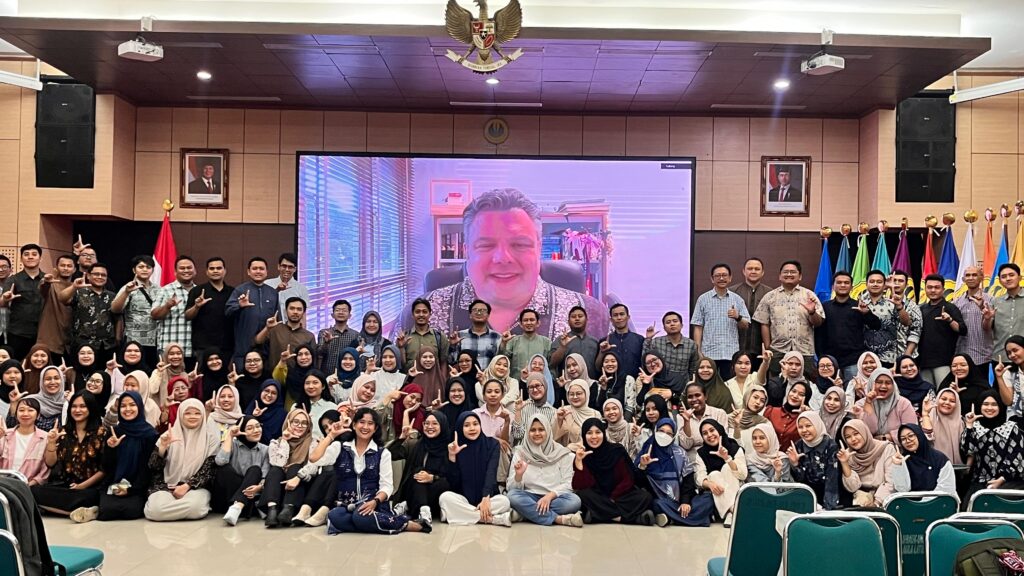
Presenting to 200 students remotely was a daunting challenge, but everyone’s enthusiasm made it a success.
Note: The pre-workshop survey discussed in the post was a voluntary needs assessment used to tailor the session; it was not conducted as a research study.