This week, I joined the second annual meeting of the AUN-Digital Transformation (AUN-Dx) Thematic Network. This is an especially significant moment for the network: the conclusion of a major drafting and piloting process for an AI governance and ethics framework and the beginning of a new phase of implementation.
Why a Shared Framework Matters
The Annual Meeting at Universiti Brunei Darussalam brought together colleagues from the Association of Southeast Asian Nations (ASEAN) who are working to strengthen responsible digital transformation in higher education. I entered a community shaped by years of workshops, pilot assessments, and collaborative drafting.
One important function of an AI governance and ethics framework is to promote the transparency needed for collaboration between institutions. It is easy to take for granted the many affordances that enable collaboration between universities. For example, IRB procedures and protections for private health information are locally established but internationally understood. Institutions might have different definitions of important concepts – such as indirect-cost rates – but the list of concepts is known and each institution has established its own definitions.
Because users are developing new ways to implement AI, its fit with existing policies is still being tested and new challenges are still emerging. Collaboration depends on institutions making their policies legible to one another. The AUN-Dx framework is a way to provide a shared starting point.
Two Examples from the Annual Meeting
The panel I chaired provided two contrasting examples of why a governance framework is needed, from cross-border and national perspectives.
The presentation by Assoc. Prof Cherdchai Nopmaneejumruslers, MD, made me think of the challenge from the perspective of international medical research. It is a known problem that medical research spanning datasets from different contexts can increase the risk of error because of differences in collection methods, populations, or regulatory conditions. A federated methodology is needed – in traditional or AI analysis – which involves analyzing data in its contexts, and AI tools will be operating across national boundaries to do so. A governance framework can provide the transparency and shared standards needed for researchers to trust one another and the resulting analysis.
Prof. Donata Acula, Ph.D., described a grant project in the Philippines that brought together representatives of different universities to start the process of developing their institutions’ AI policies. Different institutions are at various stages of developing their own policies, but all can benefit from the starting point offered by the AUN-Dx framework. Her project also demonstrated the value of a community approach, through which institutions at different stages of policy development can learn from one another.
Building Trust with Consensus Governance
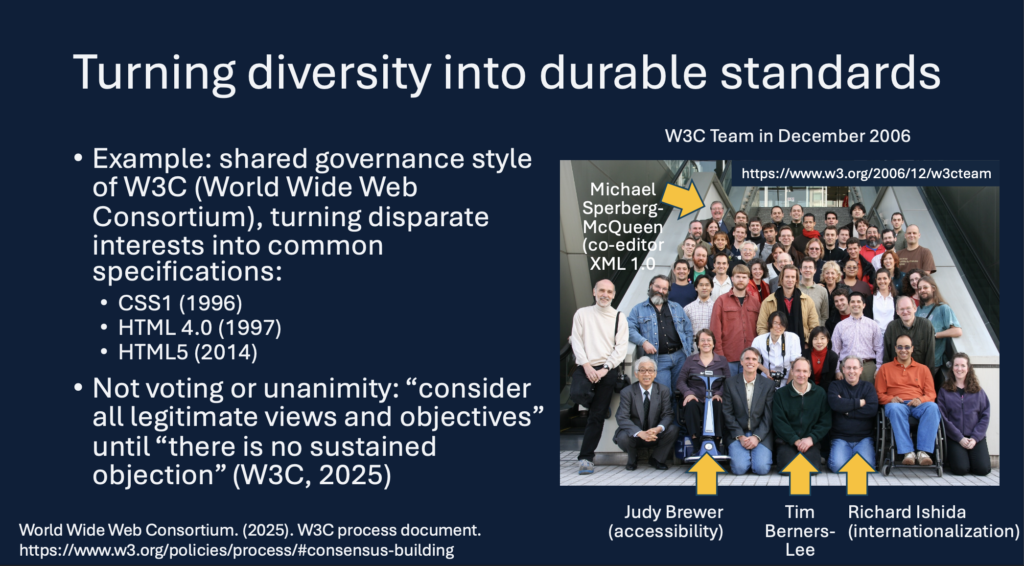
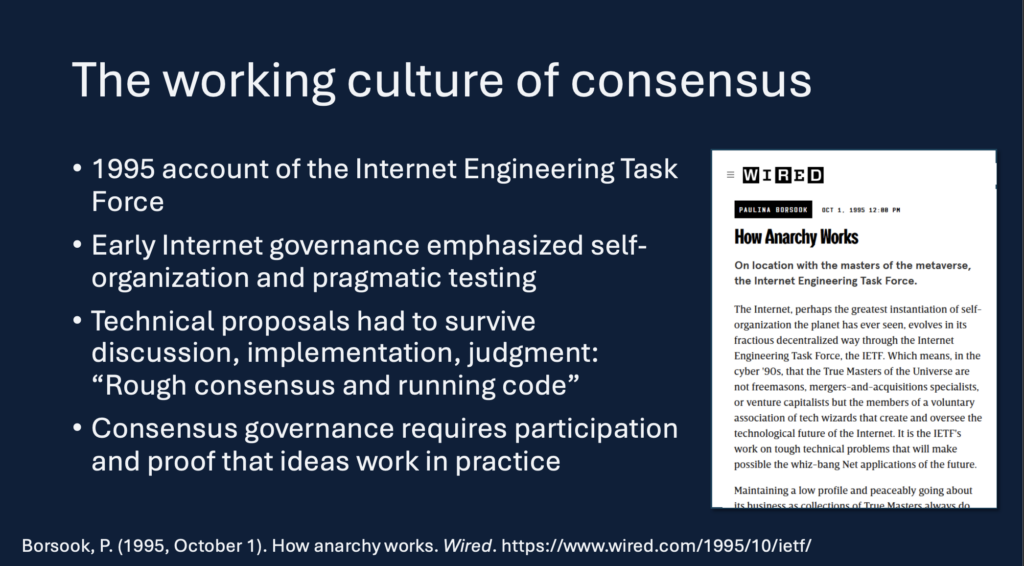
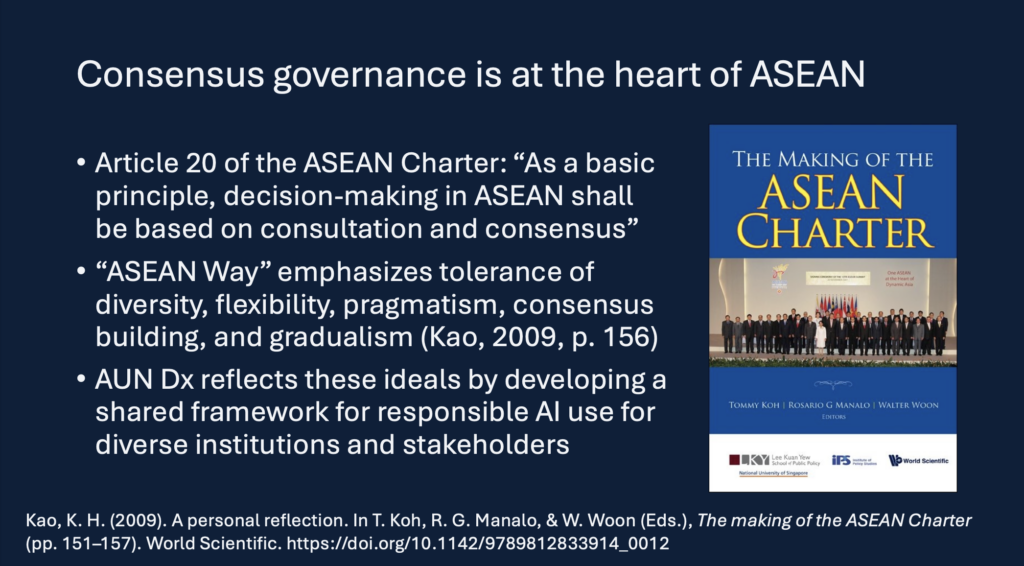
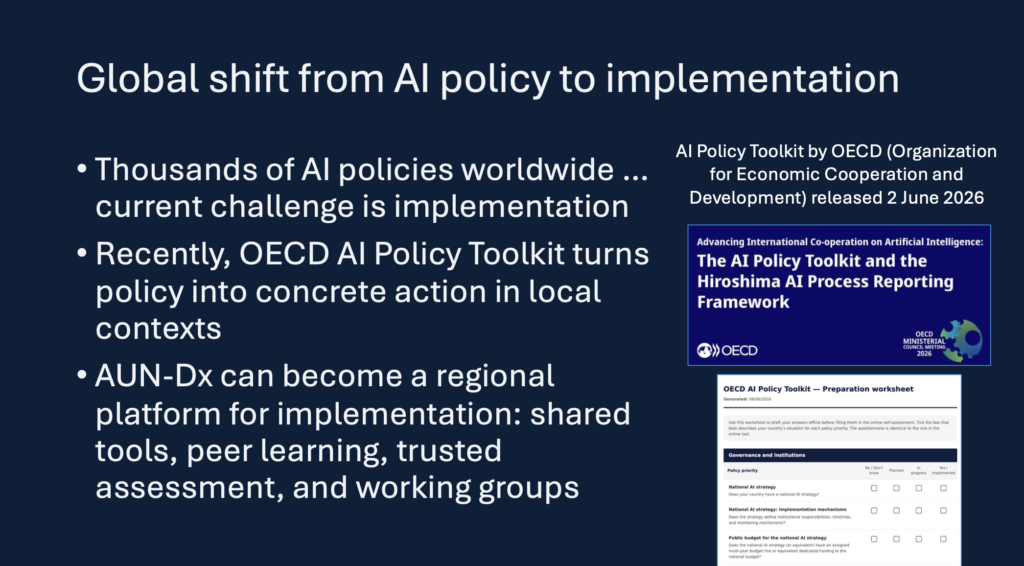
My presentation, “Building Trust with Consensus Governance,” examined how shared frameworks can turn institutional diversity into coordinated action (see selected slides below). I began with examples from the consensus governance traditions found during the early history of the Internet and the Web.
For example, the World Wide Web Consortium’s (W3C) collaborative development of Web standards such as HTML and CSS demonstrates the potential of consultation, shared responsibility, and sustained attention to different perspectives. I also discussed the Internet Engineering Task Force’s mantra, “rough consensus and running code,” which was repeated during later sessions at the meeting. After this, I connected this collaborative style to ASEAN’s own emphasis on consultation, flexibility, pragmatism, and gradualism.
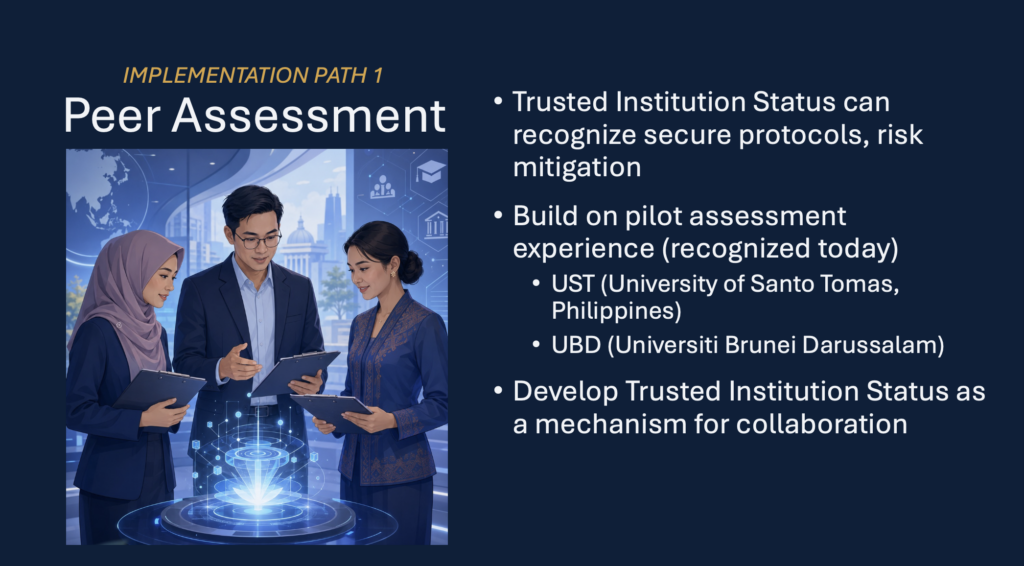
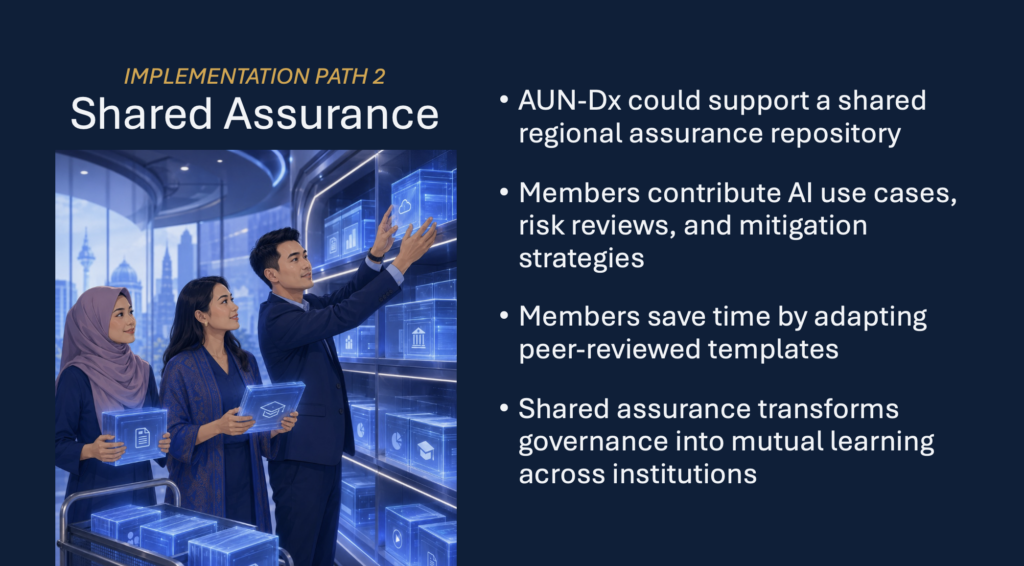
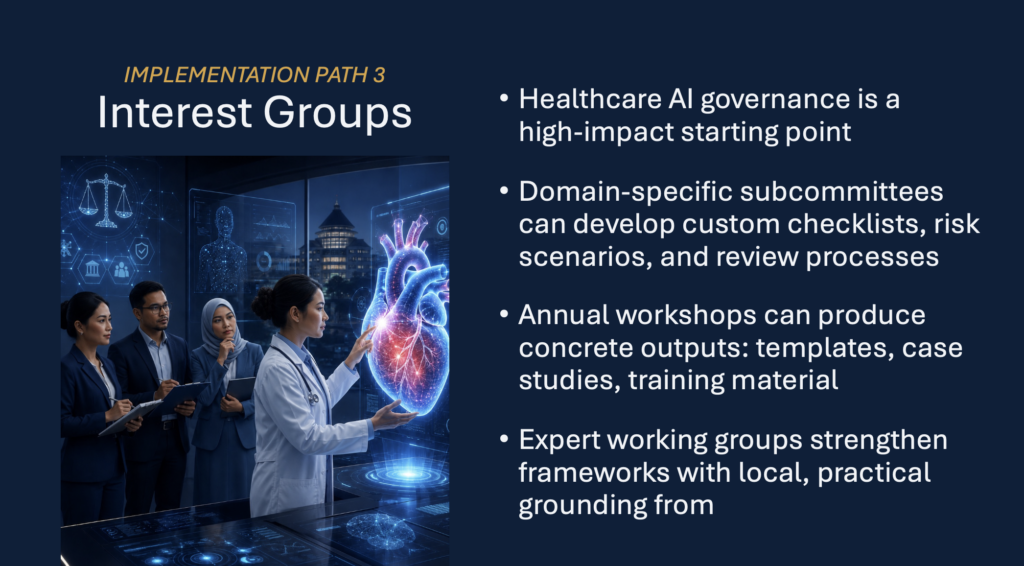
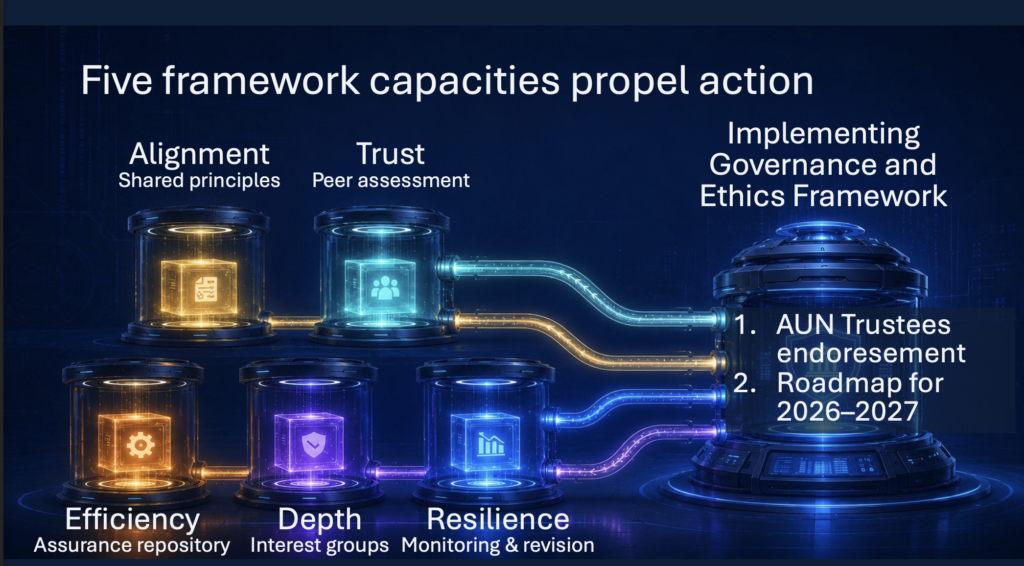
The final part of my presentation focused on the shift from policy to execution, outlining several practical pathways identified by the network’s leadership, such as peer assessment, Trusted Institution Status, a shared assurance repository, domain-specific subcommittees – e.g., a group dedicated to AI and healthcare – and continuing monitoring and revision.
From Framework to Implementation
The question and answer period was illuminating. One of the several great questions was about the evolution of AI. The AUN-Dx framework addresses AI quite generally, even though imminent new forms, like agentic AI, will offer distinct challenges. My response was that the AUN-Dx group does not seek a “one-and-done” framework that will serve as a static constitution. As the success of W3C demonstrates, frameworks are established and refined in the consensus style. The key to meeting new challenges is having a consultative community that is accustomed to evaluating and advising member institutions.
In order to support this point, I made an analogy from my experience with the International Federation for Information Processing (IFIP), which forms technical committees and working groups as new challenges arise. These groups have lifecycles; as the urgency of the issues waxes and wanes, so does interest and participation. AUN-Dx is starting to follow this kind of model through the establishment of a healthcare interest group, with the expectation that other groups will follow.
Another interesting question was what to do if an institution is uninterested in using AI tools or making AI a part of the curriculum. My response was that the framework is not prescriptive. The consensus governance style is designed to allow for differences in style, readiness, and participation. AUN-Dx’s goal is not to require every institution in ASEAN to use AI in the same way or to mandate certain applications. Rather, its purpose is to make collaboration possible and to save institutions time and effort as they move forward.
The AUN (ASEAN University Network) is a university consortium that promotes collaboration across many areas of higher education. It consists of various initiatives, including its oldest thematic network, AUN-QA, which has a quality-assurance role comparable in some respects to Middle States or ABET in the United States. AUN-Dx is a newer thematic network, established in 2024.
The AUN-Dx AI Governance and Ethics Framework is now approaching an important milestone: consideration by the AUN Rectors and Board of Trustees in July 2026. It establishes shared principles for responsible AI use while recognizing the diversity of universities across ASEAN. Completing the framework, though, is not the end of the work; it is the beginning of implementation. Breakout sessions at the meeting offered delegates the opportunity to provide feedback on the draft framework, brainstorm ideas for implementation, and discuss what support is needed from AUN-Dx.
It was a privilege to participate in this historic moment, as shared principles begin to become shared practice.
Selected Slides