
Reflections on an International History of Technology Lecture at Diponegoro University, Indonesia
Today, I had the pleasure of thinking about my work on the history of the Internet and its new relevance in the age of AI because of the kind invitation of the Faculty of Social and Political Sciences at Diponegoro University in Indonesia. The audience of around 110 people were third-year Communication students and faculty.
For me, this was an important moment in connecting the past and future of my scholarly career. I prepared a lecture entitled “Technology’s International Histories: Communicating about the Past in the Age of Generative AI” in conversation with the publication earlier this year of Histories of Computing in Asia. Preparing the lecture offered me an opportunity to bring together historical research that I had conducted over the past twenty years and the investigation of generative artificial intelligence (genAI) that is the focus of my current book project.
What was especially gratifying was the questions following the lecture. The questions showed an interest in the implications of this history for the development of genAI. I am glad that the audience was thinking about the future of education because that is where the book proposal is heading.
An Old Story Told by New Tools
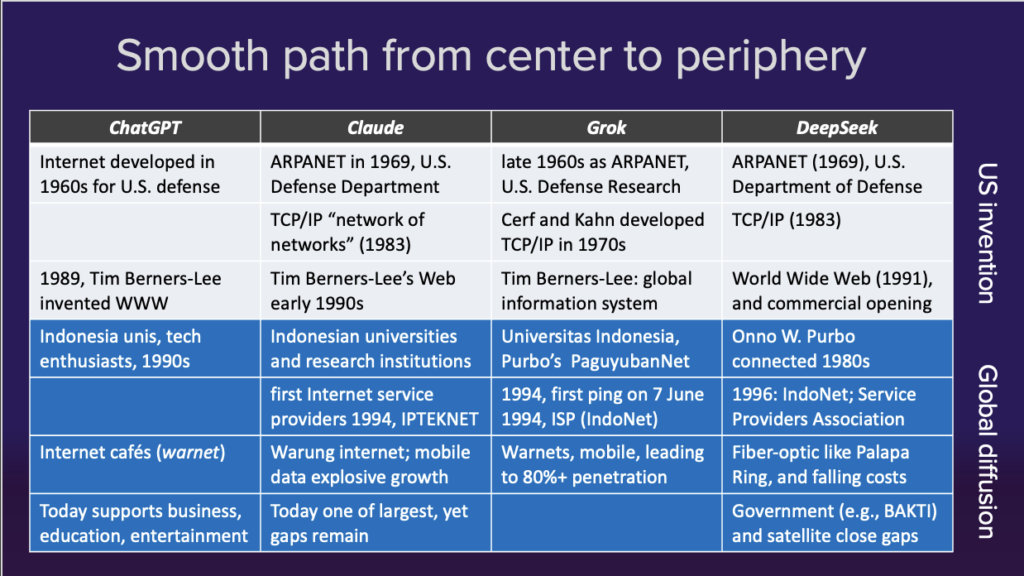
I began the lecture with an illustrative Prompt-based Discourse Elicitation (PBDE). In the line of my presentation last month at 4S, I asked four chatbots—ChatGPT, Claude, Grok, and DeepSeek—to write six bullet points about the innovation of the Internet and its spread to Indonesia.
Although there were differences in their responses, the overall structure of the narratives was remarkably similar, fitting in with my investigation of Whig history at 4S. All outputs said the Internet originated in defense research in the United States, was subsequently refined to include TCP/IP, and developed into the WorldWideWeb. Only then, in the 1990s, did it eventually spread to other countries.
Indonesia entered the story after these technological developments were completed, as if there had been no prior interest in computer networking before being connected to the TCP/IP Web in the 1990s – and then, the chatbots said, the diffusion was explosive. This was not surprising to me based on my earlier work, and it fits in with Whig thinking that focuses on geniuses making breakthroughs in an inevitable line of progress.
We all know that we need to check the facts generated by AI tools. However, there is something else we should notice: the way the facts are organized into a narrative.
This particular narrative frame is familiar to historians of technology. Whiggish history interprets the past as a series of developments leading more or less inevitably to the present. It privileges the contributions of exceptional individuals and institutions and tends to make technological progress seem independent of the social circumstances in which it occurs. In this way of thinking, the present is the inevitable result of past progress; because the present is the result of a linear path, it is almost as if it is unnecessary to study history.
I have been lucky to study and teach alternatives to this limited way of thinking for more than 20 years. I taught my first “history and philosophy of the Internet” course in Germany during my first Fulbright, and then continued the work at Polytechnic University (now NYU’s Tandon School of Engineering). This audience honed my thinking in important ways. First of all, my students were foreign nationals or children of immigrants, making me think about the international history of technology. In addition, so many of my students were science and engineering students – particularly in electrical engineering and computer science – and their background knowledge challenged me to get the facts right. My teaching was aimed at giving them a better idea about the history of technology to help them become innovators, showing how technological development is not a simple path but involves many forking paths, coexisting alternatives, and relationships to the social world. This has led to some of my earlier publications (one on history and innovation, one on critical reading and STS, and another on the intellectual history of the Memex).
The implications of a Whig history are important. Supposedly, innovation takes place at the center, while people living elsewhere wait for technology to arrive. Furthermore, users might feel that they have little choice but to accept the worldview embodied in the technology. Although this outlook was obvious in the genAI outputs, genAI did not invent this account of technological progress. Rather, in these four responses, a new technology reproduced a very old way of thinking about technology.
Technological Solutions Develop through Dialogue
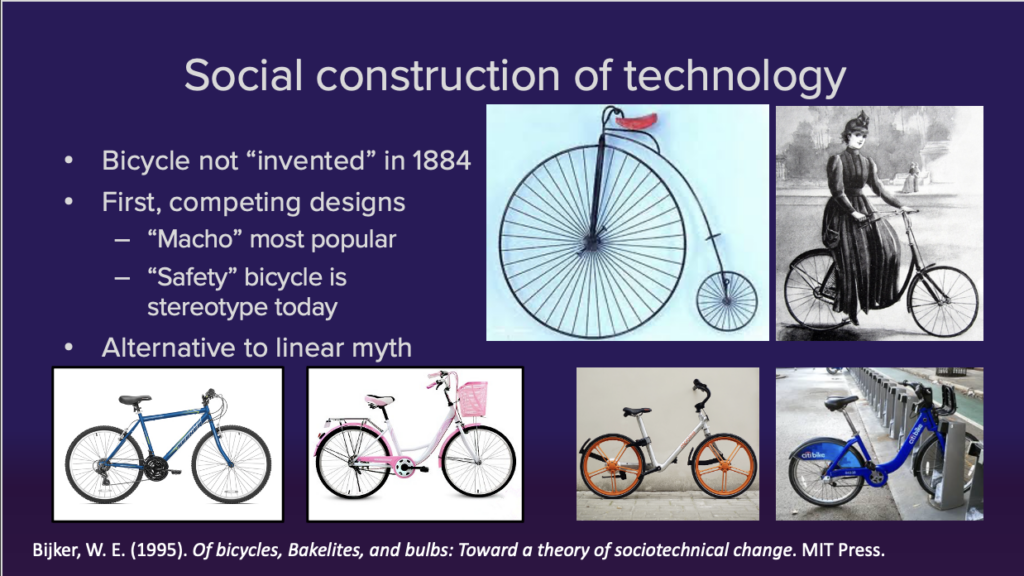
I introduced some alternative approaches to technological history from Science and Technology Studies (STS). A particularly effective example is Wiebe Bijker’s (1995) history of the bicycle. What eventually became the familiar bicycle was once just one of several competing designs. The characteristics that made the high-wheeled bicycle attractive to adventurous young men were precisely the characteristics that made it unattractive to many other prospective users.
The history of the bicycle cannot be understood simply as the successive improvement of a technical device. Different social groups had different ideas about what constituted an improvement. The bicycle story is a good parable about innovation, and more recent development can explore Bijker’s thinking further. For one thing, the cultural shaping of the gendered bicycle models – the women’s model with a low bar – were the result of women’s fashion at the end of the nineteenth century. Even though women later wore pants, this low bar remained. Thus, the bicycle shows the longevity of cultural impacts after their usefulness. Also, it has been interesting to see this standard design change in the era of share bikes, when the two-gender design became impractical.
A related concept is Arnold Pacey and Francesca Bray’s (2021) notion of technological dialogue. Instead of imagining that a device is transferred intact from one society to another, we can investigate the innovations that occur when technologies cross social, economic, linguistic, and cultural boundaries. Pacey and Bray offer many illustrative developments of technology, such as Gutenberg’s printing press, where moving technology across borders resulted in friction rather than smooth transfer. Thus, cultural differences offer strong opportunities for innovation.
These insights, which contribute to a constructivist point of view, offer a useful alternative to the language of inevitable technological change that we encounter today.
The Internet Was an International Innovation
Much of my earlier research concerned the international scientific communities that contributed to Internet technology. The potted history of the Internet is that it was developed in isolation as a U.S. military research project, and then spread to other user groups once it was perfected. This story is understandable given that documents about the Internet’s history rarely mention research outside the U.S., but that’s a function of the military funding that should not be dependent on outsiders.
Plenty of researchers, including me, have worked to show the history of the Internet with a wider lens. In a paper published in 2013, I examined the limitations of the familiar account of the Internet as an innovation originating in U.S. military research. Without diminishing the importance of the ARPANet project, I wanted to draw attention to the considerable international research activity that helped make the Internet possible.
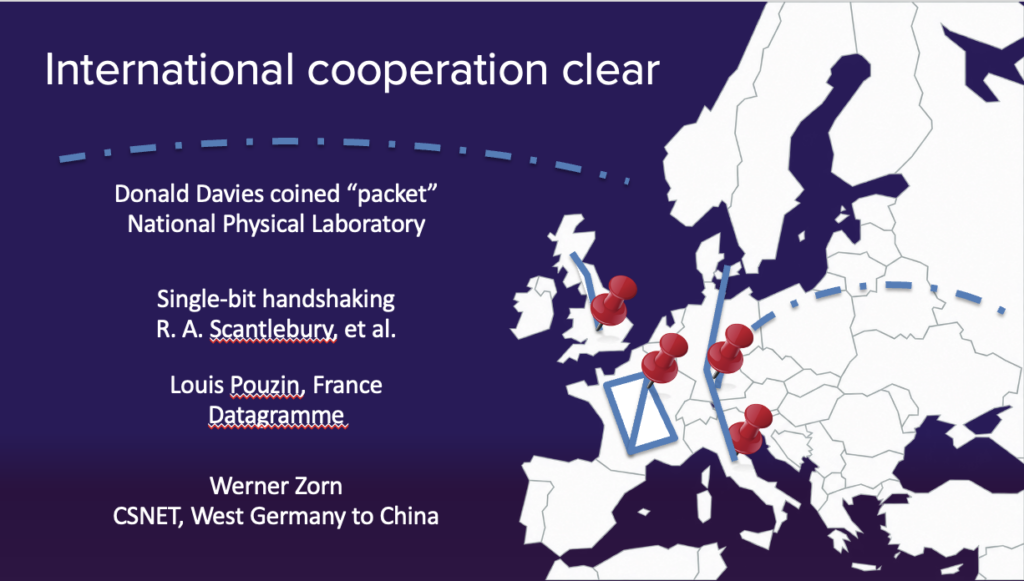
For instance, researchers in Britain were investigating packet switching with different objectives. In France, Louis Pouzin and his colleagues were developing ideas that contributed to the ability to interconnect different networks. By the late 1970s, numerous public and private packet-switched networks existed or were being planned. The Internet did not simply grow out of one isolated military research project. It developed in a world where many people were already interested in electronic communication, often for quite different reasons.
My subsequent research considered the international relationships that helped extend computer networking. In a 2019 paper on computing blockades during the Cold War, I investigated the circumstances that made electronic communication between Chinese and West German researchers possible. Establishing an electronic-mail connection required considerable cooperation.
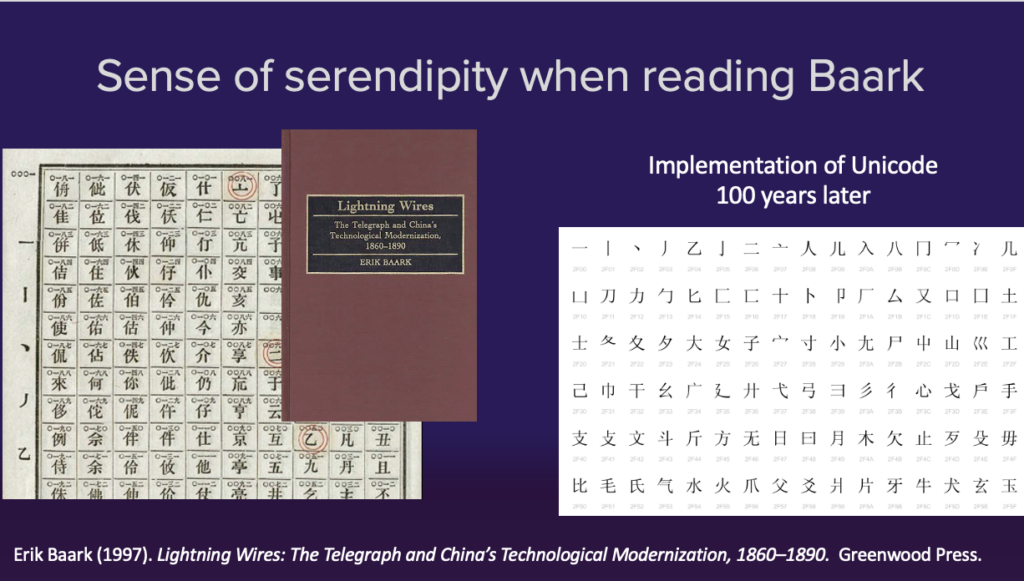
More recently, my research on the introduction of telegraphy to China demonstrated another aspect of technological dialogue. Although Morse code was based on the Roman alphabet, the introduction of the telegraph did not require Chinese users to abandon their writing system. Innovations in character encoding allowed an existing cultural practice to be accommodated by the new technology. It is interesting to look at nineteenth-century Chinese telegraph codes with knowledge of the later development of Unicode. As my paper points out, it is also interesting to realize that the English-only Internet was a design decision based on politics more than a necessary technological constraint.
Looking for the Internet’s Histories in Southeast Asia
In preparing the lecture, I became aware of how much more I need to learn about the early history of computer networking in Southeast Asia. I am grateful for the opportunity to think about this more, even though I know I have barely scratched the surface.
Even my brief, preliminary investigation revealed some interesting developments in Indonesia: the establishment of domestic satellite communications in 1976, the inter-university computer network UNInet in the 1980s, cooperation among Asian networking researchers, and the efforts of Indonesian engineers to develop inexpensive computer networks using amateur radio. These developments – before the arrival of the commercial Internet, have an interesting fit with other constructivist histories.
Reading these documents reminded me of other historical developments I had studied. Existing expertise in electronic communication, international relationships among researchers, and the need to overcome local technical and economic constraints were important aspects of Internet innovation in other parts of the world as well. The Indonesian engineers and hobbyists working in the 1980s also help to explain how the Internet exploded in popularity: they laid the technological groundwork and intellectual expertise to make the Internet find a home.
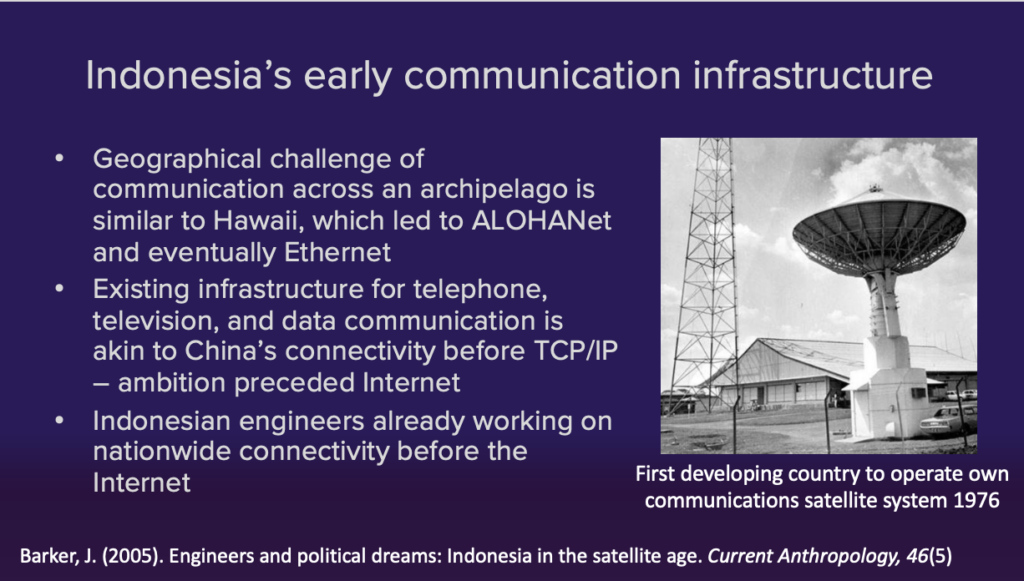
These are not merely stories about the arrival of a U.S. technology in Indonesia. They are part of the international history of the Internet. There is much more to investigate here, particularly concerning the relationships among networking researchers in Southeast Asia.
Who Has the Opportunity to Write History?
My involvement in the International Federation for Information Processing (IFIP) has also made me aware of the circumstances that influence the geographical distribution of historical scholarship. Even in the U.S., STS and the history of technology are niche fields. You can find this research capability at top engineering and science universities, like MIT, but it is not a highly ranked or desirable research area. Outside of the U.S., it can be even rarer. This has important implications because scholars from the U.S. predominate – and because they write the most Web pages, articles, and books, their worldview is the default stance of chatbot output.
In 2025, I conducted a preliminary country-frequency analysis of 17 volumes associated with IFIP Working Group 9.7 on the History of Computing. Unsurprisingly, references to countries in the global north and global west predominated. However, there were some interesting patterns within that distribution, including the prominence of Scandinavian countries, Russia, and Australia. The location of workshops and the interests of the people organizing them appeared to influence the geographical coverage of the resulting publications. Even an organization established to promote international cooperation does not automatically generate a geographically representative body of knowledge.
This is an important consideration in the age of genAI. Inequalities in the historical production of knowledge can be reproduced by technologies that generate seemingly authoritative accounts of the past.
That being said, I am prouder than ever of the IFIP working group about the history of computing because they offer a forum for English-language scholarship about the history of the Internet and computing more generally. That mission seems more important than ever.
Three Questions about the Future
Although I had spent much of the lecture discussing the past, I was clearly thinking about the future. Always with this kind of work, I am trying to explain how our thoughts about the past impact how we pursue innovation for the future. Nowadays, I am also thinking about the future of genAI technology, not to mention the future of the humanities in the algorithmic age.
What was great about this presentation is that the questions from the audience picked up on this theme of using an understanding of the past as a springboard into the future. (What follows is a reconstruction of the discussion rather than a verbatim transcript.)
The first question was methodological: How can we begin studying the history of computing when we know relatively little about it? This question is especially important if we want to encourage a more international history of technology. How can people begin historical research in this field when they have not had extensive opportunities to study it?
I am well aware that my opportunity to teach and conduct research in the history of technology represents a form of unearned privilege. My 20 years of effort were possible because I was working in an STS program and because this interdisciplinary work led to research grants (including the Fulbrights that brought me to Germany and later to China). As I have learned when trying to put together research workshops on the history of computing for IFIP, most faculty have little opportunity to do work of this type or to find a forum that appreciates it.
Yes, it is true that there is a lot to know. Like any other journey, though, you take it one step at a time. I encouraged participants to start small. There may be interesting stories about technological development at their own universities or in their local communities. These stories can be investigated and subsequently connected to analogous developments in other places and to the existing scholarly literature. Contributing to international history does not necessarily require beginning with a major research project of the whole history of the Internet.
The second question boiled down to, will universities still be relevant in the future? My answer is yes, but maybe not the way we might think. It is true that genAI can provide immediate answers to any questions, sometimes better than what individual scholars can do. However, I remember this worry at other technological junctures. When YouTube first came out, my students said universities were irrelevant because you could learn anything you wanted to know from videos. The same kind of argument was made when Google Translate came out, making students feel as if there was no more need for multilingualism. It is true that technological developments change the emphasis of our work, but it does not mean that our work is irrelevant.
GenAI models depend on previously produced materials. We have known for decades that the international production and circulation of information is disproportionately influenced by institutions in the global north and global west. Although there are interesting initiatives to develop national and locally oriented AI systems, it remains to be seen how successful or influential they will be relative to systems such as Claude. Interestingly, this makes education more important than ever.
Many of the topics that students encounter in Communication departments—bias, stance, worldview, and the sustainability of information—have acquired new relevance. We need people who can recognize the assumptions in apparently neutral accounts of the world and who can produce knowledge that reflects different circumstances and experiences.
I am also concerned about the enthusiasm for making education more efficient and less expensive through genAI. It is possible that we will find ourselves in a situation where only the elite are afforded the opportunity to read extensively, work through difficult problems, and learn to think independently. Others might be offered a supposedly efficient education that relies heavily on AI-generated explanations and assistance. For hundreds of years, the trend has been to widening the availability of education. Now, I fear, we are at risk of a regression to a time when only the elite get genuine education. The important educational inequality of the future might concern not only access to technology but also access to opportunities for intellectual development independent of it.
The final question concerned humanity, and it was perhaps the most difficult question of the afternoon – and the most important. This question boiled down to, Are AI systems conscious?
I do not have a satisfactory answer to the question of machine consciousness. Contemporary genAI certainly demonstrates many of the communicative capabilities that would make it a compelling participant in a Turing-style test, although this does not settle the question of subjective experience. I also understand the attraction of having a system with which one can discuss private concerns. The ability of these systems to make jokes and produce what appear to be self-reflexive observations sometimes unsettles me.
However, the development of these technologies gives us an interesting opportunity: we can seriously consider what it means to be human. What does it mean to think? What does it mean to create? What are we doing when we communicate with another person? This is another reason why I think the humanities are more important than ever.
In my answer, I briefly mentioned a line of thinking I have been developing in connection with Donna Haraway’s discussion of the homework economy and the transformations associated with information technologies. Perhaps our task is not so much to resist technological change as to survive the diaspora it produces. What do we want to carry with us? We frequently hear that genAI can make our communication clearer, more concise, and more effective. These are qualities that Haraway associated with the informatics of domination, calling on oppositional cyborgs to fight for humanity. Clarity is not necessarily the most important thing about human communication. Our emotions, aspirations, dreams, and ideals give significance to what we say and write.
These considerations have not become less important because machines can produce sophisticated language.
Looking Back and Looking Forward
I was very pleased that the historical background of the lecture encouraged students to think about these questions. My current research investigates the assumptions about knowledge that become apparent in genAI output. The lecture at Diponegoro University helped me see more clearly the relationship between this project and my earlier historical scholarship. At a time when we are told that machines can undertake many of the tasks that have traditionally occupied historians, educators, and scholars in the humanities, I find it interesting that these fields of inquiry may have become more consequential than ever. This has showed to me that I am on the right path with my book project.
I am grateful to Diponegoro University for providing me with an opportunity to think about these relationships.
The attached file has a bibliography of the talk.