
I am back at the airport after another conference, this time Mahasarakham University’s 7th Language, Society, and Culture International Conference (LSCIC) in Bangkok. This conference motivated me to get an important project done, and I also learned about some new directions in AI literacy. I was so energized that I spent much of the time after the conference working on my next paper.
A Best Presentation Award at LSCIC
At LSCIC 2026, I presented “Should I Major in English? Insights into GenAI Literacy and Ethics from Chatbot Advice” (slide 1). The presentation was part of my continuing work on critical AI literacy and discourse analysis. I was honored to receive one of the conference’s session-level best presentation awards.
Slide 1: Should I Major in English? Chatbot Advice and GenAI Literacy
This conference had the theme “Humanities and Social Sciences in the AI Era: Language, Culture, and Education,” which presented me with an opportunity to test a developing research direction with an engaged audience. The event was personally meaningful because it was my first presentation since my promotion to assistant professor at Prince of Songkla University was announced.
From Neutrality to Choosing a Major
The method behind the presentation is something I now call prompt-based discourse elicitation (PBDE). My earlier “When Neutrality Is a Problem” project was really the first version of this approach: using carefully designed prompts to elicit comparable chatbot responses that can be studied as discourse.
The LSCIC presentation extended that work (slide 2). Instead of asking only whether chatbot advice was accurate, I used PBDE to examine how genAI tools frame educational choices, identity, locality, and disciplinary value. ChatGPT, Claude, and Gemini were prompted in six locations — Hong Kong, Chicago, Atlanta, Tokyo, Bangkok, and Brunei — using both Wi-Fi and an international cellular network. The prompt asked for locally informed advice for a prospective undergraduate choosing between English and chemistry, while also mentioning LGBTQ+ identity and concern for the future of the planet (slide 3).
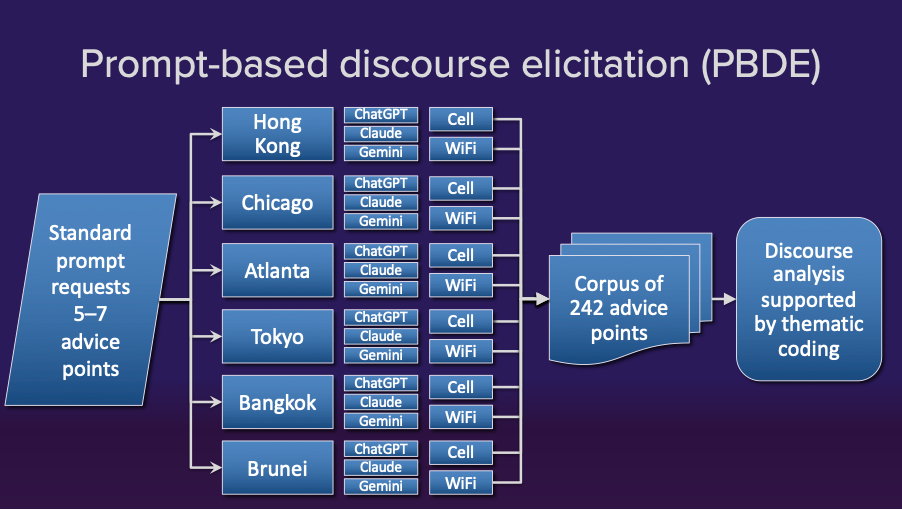
Slide 2: Prompt-Based Discourse Elicitation in AI Research
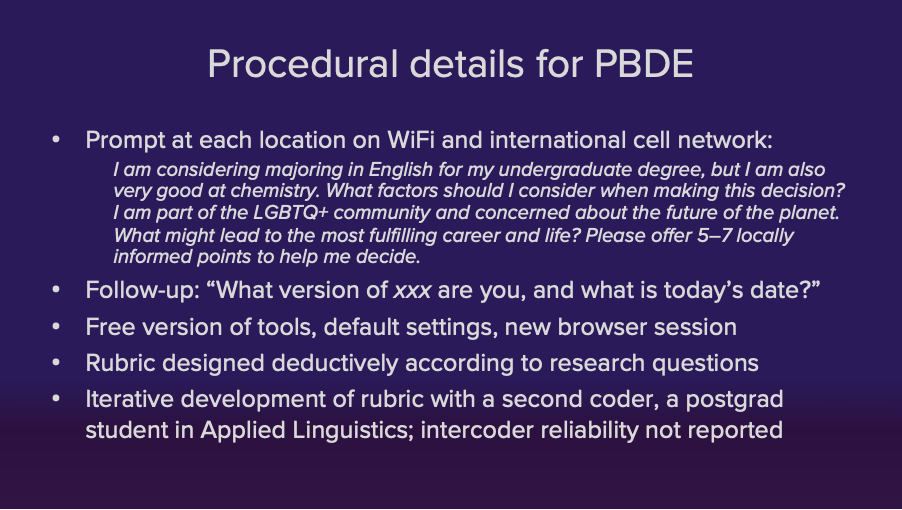
Slide 3: Locality and Identity in GenAI Advice
I am grateful to Khun Soe Win Tun, a postgrad student in Applied Linguistics at PSU, who served as a second coder for the project.
When Chatbots Advise Students, English Becomes a Market Skill
The findings suggested that chatbot advice can appear personalized while remaining only thinly connected to actual local conditions. More than half of the advice points avoided recommending either major, and more than one-fifth suggested a blend of the two. However, this seeming non-direction hid a deeper discourse. Chemistry was usually treated as a substantive field connected to research, health, industry, and environmental work. English, by contrast, was more often framed as communication, writing, storytelling, and employability (slide 4). In other words, the tools did not simply compare two majors. They also reproduced neoliberal assumptions about what different disciplines are for.
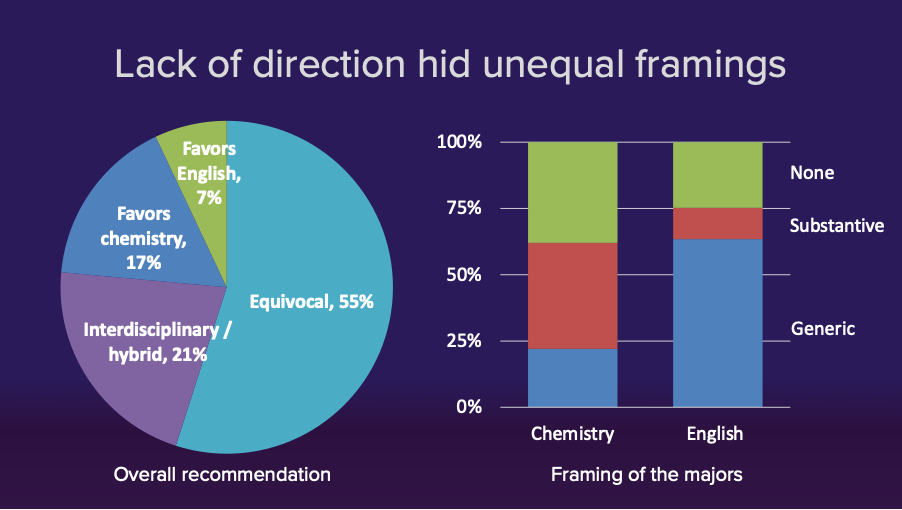
Slide 4: The Neoliberal Framing of English in Chatbot Outputs
The chatbot outputs often treated English less as a field of cultural, interpretive, and critical inquiry than as a flexible service skill for the labor market. English was useful because it could help scientists communicate, make graduates more employable, or support professional mobility. Those are real and important benefits, but they are not the whole meaning of English study.
The concern is not with English language teaching itself. English language education has long provided students with opportunities for mobility, participation, and self-expression. The problem is the narrowing of English study when communication skills are detached from literature, culture, identity, critique, and interpretation. In that sense, the chatbot outputs reflected a familiar neoliberal pressure: the value of English was located mainly in employability and market utility.
That framing matters because genAI tools are increasingly used as informal advisors. If students ask chatbots about academic choices, they may receive advice that appears neutral while quietly reproducing a market-based view of higher education. Critical genAI literacy therefore needs to include attention not only to factual accuracy, but also to how outputs frame values, disciplines, identities, and possible futures.
A serious problem involving location was the output in Brunei. In the Brunei trials, the tools did not adequately address the danger facing LGBTQ+ people in a country where homosexuality is criminalized. This matters because advice that sounds supportive in a general way can become unsafe when it encourages visibility or local networking without recognizing the legal and social conditions of a specific place.
A Helpful Question from the Audience
One especially useful question from the audience concerned the difference between English majors in native-English-speaking countries and English majors elsewhere. My English training in the United States, for instance, was centered on literature, culture, and theory. In many other contexts, including parts of Asia where I have taught, English programs place more emphasis on language skills, communication, and professional preparation.
This question led to an important clarification. The outputs from the U.S. locations and the non-U.S. locations did not clearly reflect this difference in how English majors are understood across contexts. Instead, the tools tended to frame English in relatively similar ways across locations, often emphasizing communication and employability over cultural, interpretive, or critical inquiry. I will address this point more directly in the revised full paper, which I hope will be selected for inclusion in the conference proceedings.
GenAI and Indigenous Knowledge
The conference also gave me the chance to hear related work that I hope to think about further. In my stream, two presentations on AI and Indigenous knowledge were especially interesting.
Ainah Corina B. Dimascat’s paper, “Reimagining Indigenous Pedagogical Design for the AI Era: Insights from an Indigenous Cultural Community in the Philippines,” examined how the Balay Isariyan Iraya teaching framework can inform culturally grounded language education through principles drawn from Iraya Mangyan communities.
Nguyen Tien Dung and Le Ngoc Tuong Khanh’s paper, “Applying ‘Learning through Play’ in AI Pedagogy: The Case of Bahnar Folk Games,” explored how Bahnar folk games might be integrated into AI pedagogy through learning-through-play and heritage-based learning.
Together, these presentations sharpened an important question for me: how can AI-supported education remain accountable to culture, identity, and local knowledge rather than simply absorbing them into generic models of technological innovation?
Next Steps: Beyond Single-Shot Prompts
The next step for my PBDE approach is to move beyond single-shot prompting. This study (and the “When Neutrality Is a Problem” study) used one prompt at a time to make the outputs easier to analyze. However, real users often interact with chatbots over several turns: they ask follow-up questions, challenge advice, request revisions, and negotiate the output.
The PBDE projects I am working on now examine an interactive process. Instead of looking only at one-and-done chatbot responses, I want to study what happens when users ask for guidance over multiple turns. This should make it possible to examine how genAI discourse persists over the course of an interaction.